Homer L. Twigg IV
Investigating the Mezzocosm
Recent Photos
January 31, 2013
leave a comment

January 24, 2013
Mass for the Conversion of St. Paul
The title of the Mass almost makes me feel like we schmucks are still praying for St. Paul’s conversion, as though he needed it and not us!
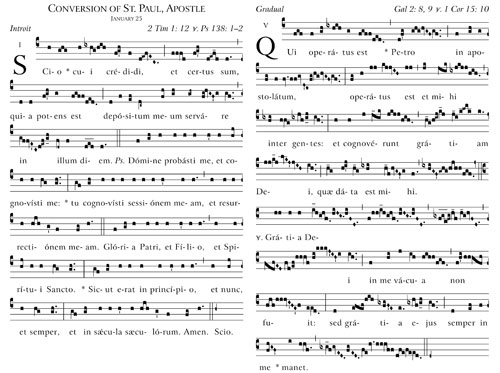
Alleluia: Magnus Sanctus Paulus
Introit: Scio Cui Credidi
Gradual: Qui Operatus Est
Communion: Amen Dico Vobis [quod vos]
January 22, 2013
Doppelgänger of the Day
Augmented (hyper)Reality: Domestic Robocop from Keiichi Matsuda on Vimeo.
But they looked clunkier than the pair spotted on the subway in the picture taken, by passenger Noah Zerkin who posted it on Twitter today.
Zerkin describes himself as a “wearable computing and augmented reality enthusiast/hardware prototyper,” but told Twitter that he had got into the same subway carriage as Brin by coincidence. He said he had had had “a brief conversation with the most powerful man in the world. On the downtown 3 train. Nice guy.”
January 15, 2013
Everything you’re gonna get, anyway.

via Instagram, powered by ifttt. #nothing is the new #everything. #sartre #bagels #existentialistbaking #starbucks

January 14, 2013
The ITC’s ‘Perspectives, Principles, and Criteria’ & The Exemplary Theology It Points To
The ITC’s recent document Theology Today: Perspectives, Principles and Criteria is a symbol of a major milestone for the Synod of Bishops, who have been pouring time and effort into the International Theological Commission since it was proposed in 1967. Like the Synod, it was meant to cultivate the collegial experience of the bishops. At the same time, the Synod was witnessing the fruitful interaction of theologians and bishops, and wished this spirit to continue. Two years later, in October of 1969, the ITC held their first meeting. The commission is composed of a members from all over the world, serving 5-year terms, and are appointed by the bishops. Cardinal Ratzinger was one of the founding members of the ITC, serving two terms as the president. He was not eligible to serve in the third term, as he had recently been made a Bishop. Nevertheless, he has been personally involved with the ITC since its inception. In the preface to Volume I of the ITC’s compendium of published work, Cardinal Ratzinger writes,
The special contribution of the Commission is to gain a hearing for the common voice of theology amid all the diversities that exist. For notwithstanding the legitimate pluralism of theological cultures in the Church, the unity of theology must remain, and empower theologians to offer some common account of their subject. In these pages, therefore, one will not find the exciting theses of innovative individuals.[1]
At the beginning of the most recent quinquennium, the ITC chose three topics that they wished to investigate and develop, the role of the theologian being one of them. It was prompted by the progressively amoebic contours of the theological enterprise in the academic and religious world, and a demand for some critically crafted criterion. The document’s particular audiences, as Msgr. Paul McPartlan mentioned in a recent lecture[2] are Catholic universities and seminaries.
“Theology Today: Perspectives, Principles and Criteria” was met with both fanfare and criticism, though nearly all news articles and citations in academic journals have found something exciting and positive about it. The National Catholic Reporter lamented the lack of casuistry, writing that “unfortunately, the commission does not get explicit about such practical matters” such as “the morality of contraception, about extending the priesthood to women, about the selection of bishops in the church…”[3] Other Catholic journals focused sharply on the documents’ discussion of the sensus fidelium. What Msgr. McPartlan referred to as a “fine nuance” America called “a precedent-setting treatment … an exposition of reading the signs of the times that makes historicity a principle of contemporary theology and an evocative pointer to spiritual experience as a theological source.”[4]
The goal of this essay is to offer some observations about which “exciting theses of innovative individuals” the ITC’s new document points to (but explicitly omits), based on the criteria it offers. I will not attempt to hand out gold medals, pick losers or provide comprehensive sets. Rather, the ITC’s document is uniquely interesting because the criteria have arisen out of an observation of good theology that’s already happened, and not vice versa. Therefore, in the spirit of both a hermeneutic of continuity and a vivid appreciation of historicity highlighted by this document, I will provide one or two outstanding examples of each criterion. Lastly, it should be noted that all good theology attains to many or all of these criteria, and no good theology violates any of them.
Structure of the Document
(my comments in parentheses)
Chapter 1: Listening to the Word of God (sensus scripturam)
1: The primacy of the Word of God
2: Faith, the response to God’s Word (fides qua & fides quae)
3: Theology, the understanding of faith (The sciencia of Theology)
Chapter 2: Abiding in the Communion of the Church (sensus ecclesiam)
1: The study of Scripture as the soul of theology
2: Fidelity to Apostolic Tradition
3: Attention to the sensus fidelium
4: Responsible adherence to the ecclesiastical magisterium
5: In the company of theologians
6: In dialogue with the world
Chapter 3: Giving an Account of the Truth of God (sensus veritatem)
1: The truth of God and the rationality of theology (cf. 1.3)
2: The unity of theology in a plurality of methods and disciplines (honoring scrutiny)
3: Science and wisdom (Concession of the ineffable object of theology)
The document itself has three main chapters: the first as the response of faith to the word of God. Chapter two considers the essentially ecclesial nature of theology. Chapter three offers a significant theology of the rationality of theology. All together there are twelve criteria. The aim, as one member of the ITC said, was to identify “the DNA of good theology.”
The first criterion summarized in paragraph 9 states that “a criterion of Catholic theology is recognition of the primacy of the Word of God. God speaks ‘in many and various ways’ – in creation, through prophets and sages, through the holy Scriptures, and definitively through the life, death and resurrection of Jesus Christ, the Word made flesh.” (cf. Heb 1:1-2)
The Word is deeply personal in the same way that the Faith is. What they share is that they are a striking experience of God. Revelation is a cooperative knowledge of truth which saves. It is profoundly personal and ecclesial, one which seems to be the right contrast and counterpoint necessary to overcome the 20th century tendency to veer off into a strictly experiential theology, or else a fideistic one. The balance of faith and reason overcomes this tendency. The goal of the document is to awaken theologians to “the mind of Christ,” as St. Paul writes. Central to this first point is the relationship of the final beatitudo to intellectus fidei. An outstanding theologian that is founded deeply in this criterion is one of the Church’s newest Doctors, Hildegard of Bingen. The Scivias, which contains a seamless blending of experiential knowledge, prophecy, holy scripture and contemplation. Hildegard’s ability to move between different forms of the Word of God is worth not just admiration but imitation.
The second point, summarized in paragraph 15, states that “a criterion of Catholic theology is that it takes the faith of the Church as its source, context and norm. Theology holds the fides qua and the fides quae together. It expounds the teaching of the apostles, the good news about Jesus Christ ‘in accordance with the Scriptures’ (1Cor 15: 3, 4), as the rule and stimulus of the Church’s faith.” The core affirmation of Vatican II is that “the study of the sacred theology should be the soul of theology.” (23) Theologians must recognize that scripture is divinely inspired and directed towards salvation. Therefore, it must be read and interpreted in the same way it was written (Dei Verbum 12).
The outstanding theologian that comes to mind as someone who takes the “faith of the Church as its source, context and norm” is Pope Leo the Great. His Tome was as important in forming the Church at the Council of Chalcedon as was his meeting with Attila. In his efforts to concretize the Church under the banner of a synthetic statement of faith, infused with scripture, Leo rightly takes the epithet “Great.” But his work as a theologian is particularly related to this point, for the dissemination of his work on the Trinity definitively set Rome at the center of all future theological debates. To the degree that he established the chair of Peter the Axis mundi of all future theological debates affecting the Catholic Church, he is a perfect example of a heroic and saintly life corresponding to holy writing.
The first criterion of the second part is summarized in par. 24, stating “a criterion of Catholic theology is that it should draw constantly upon the canonical witness of Scripture and should promote the anchoring of all of the Church’s doctrine and practice in that witness, since ‘all the preaching of the Church, as indeed the entire Christian religion, should be nourished and ruled by sacred Scripture’. Theology should endeavor to open wide the Scriptures to the Christian faithful, so that the faithful may come into contact with the living Word of God.” (cf. Heb 4:12) This criterion bridges the gap between the primacy of the Word of God at the outset of the document, and the theologian’s relationship to scripture as he or she engages in theological study. Closely related to this point is the way in which the theologian utilizes the apostolic tradition. Theologians such as Jonathan Tram and Brian Bantum[5] are engaging new and exciting realms of experiential theology, bringing back to life sense of salvific suffering in the Church Fathers. In the second criterion of this part, the ITC writes that faithful theology “requires an active and discerning reception of the various witnesses and expressions of the ongoing Apostolic Tradition. It implies study of sacred Scripture, the liturgy, and the writings of the Fathers and Doctors of the Church, and attention to the teaching of the magisterium.” (32)
Thomas Aquinas jokes at the outset of the Summa Theologia that …ex auctoritate, non videtur hoc congruere eius dignitati, nam locus ab auctoritate est infirmissimus, secundum Boetium. Yet it is The Angelic Doctor’s unceasing reliance on the wisdom of the Church fathers which makes these “infirmissimus” arguments so strong and enduring. It is difficult to think of another Theologian who is as concerned with drawing from the wells of patristic knowledge in order to illuminate scripture.
The third and most important point of section two reads: “attention to the sensus fidelium is a criterion for Catholic theology. Theology should strive to discover and articulate accurately what the Catholic faithful actually believe. It must speak the truth in love, so that the faithful may mature in faith, and not be ‘tossed to and fro and blown about by every wind of doctrine’.” (Eph 4:14-15) (36)
There’s an important conciliar nuance here: the sensus fidelium is a unified whole, before the magisterium. Chapter II of Lumen Gentium precedes chapter III on the ecclesial hierarchy—and this not simply a stylistic move. Catholic theology thererfore requires an active and discerning reception of the apostolic tradition. Tradition ceases to be tradition if it fossilizes. (26) The discussion of sensus fidelium begins by recalling Paul’s thanksgiving for the Thessalonians for welcoming the Word of God as they have. They have an intimate sense of spiritual reality—and this is as important for theologians today as it was for Paul. Theologians need therefore to be active members of the Church, in order to know the sensus fidelium. They are charged with articulating and clarifying the sense of things around them. In paragraph 33, the document names a critical task laid on theologians as the result of this need for lay attentiveness: “to examine expressions of popular piety, new currents of thought and movements within the Church, in the name of fidelity to the Apostolic Tradition.” Here the ITC is implying that the popular piety is not a christened form of worship, and at the same time the council of Trent was not the last word on the Liturgy.
The “theologian” doing some of the most positive work related to these two criteria is Georgetown’s Center for Applied Research of the Apostolate. CARA seeks to “to increase the Church’s self-understanding, to serve the applied research needs of Church decision-makers, to advance scholarly research on religion, particularly Catholicism.” From identifying demographic crises to catechetical issues in the church, to celebrating the influx of Latino Christianity into the United States, CARA has served the Church by building up a comprehensive image of a very diverse living tradition.
In paragraph 44, the ITC summarizes the fourth criterion of the second part, saying that “giving responsible adherence to the magisterium in its various gradations is a criterion of Catholic theology. Catholic theologians should recognize the competence of bishops, and especially of the college of bishops headed by the pope, to give an authentic interpretation of the Word of God handed on in Scripture and Tradition.” The magisterium and theologians are not the same, but united in cause. The text notes the “often good and trusting relationship that exists,” but also the tensions. It recalls Blessed J.H. Newman’s dynamic interaction of the three offices of Christ in the church, and that “chronic collisions and contrasts” are not bad, but “lying in the nature of the case.” Unlike the other criteria, this point offers an exemplary theologian for study—one who continues to serve the conversation of faithful interplay and communion between theologians and the magisterium. Communion in time means that Blessed J.H. Newman stands alongside theologians today as a co-inquirer. We stand in dialogue with the saints, because the faith of the apostles is the same as the faith lived today, the faith of the martyrs, virgins and doctors of the church. Theologians inspire one another. They are role-models. And it is Catholic theologians who are best placed to “give the best possible service” in the service of their discipline. In the center of this document is the very modus operandi which it is calling theologians everywhere to imitate.
Furthermore, in par. 47 we see that the theologian works at the “frontier” of the church. Especially among lay theologians who see the gospel and life in a unique way, it is “increasingly the case” that theologians give a new articulation, a new approach to issues. They need the prayerful support of the whole Church. The work of Theologians is provisional by nature. It demands being offered to the Church for scrutiny. The self-correcting mechanism is not always adequate, especially when messages can spread as quickly as they did. This means that censure is still a real and current tool that requires prudent use.
The fifth point of the second part is found in paragraph 50: “A criterion of Catholic theology is that it should be practiced in professional, prayerful and charitable collaboration with the whole company of Catholic theologians in the communion of the Church, in a spirit of mutual appreciation and support, attentive both to the needs and comments of the faithful and to the guidance of the Church’s pastors.” Insofar as it is a “scope” criterion, demarcating the lines of communion and mutuality, it is related to the last point of this section, summarized in par. 58: “a criterion of Catholic theology is that it should be in constant dialogue with the world. It should help the Church to read the signs of the times illuminated by the light that comes from divine revelation, and to profit from doing so in its life and mission.”
I believe the theologian who best expresses this criterion is Pope Benedict XVI and his work on assimilating the fruit of the Historical Critical method and the 2nd quest in scriptural exegesis. In Dogma und Verkündigung the Holy Father (then Cardinal Ratzinger) wrote:
I am not first a literal or philosophical person, but [those things] intersect the faith of the Church. This means that from the beginning it was not important for me to be great, as those in the past (like Plato or Aquinas), but someone who lives and works, the one men can meet today. It means above all, that I have met Him in the end of the history of faith have come to know Him and in the vision of faith, as it was formulated most enduringly in the council of Chalcedon.[6]
The second volume of Jesus of Nazareth is no leisurely stroll through the history of biblical criticism but an intense investigation of 200 years of exegetical work. The Pope points out in the preface that “historical-critical exegesis has already yielded its essential fruit,” and that left uninspired by faith, the historical-critical method “does not constitute the only valid and definitively evolved rational approach; rather, it constitutes a specific and historically conditioned form of rationality that is both open to correction and completion and in need of it.” Benedict’s contribution to the proper limits of the theological enterprise is that all sciences must combine to “recognize that a properly developed faith-hermeneutic is appropriate to the text and can be combined with a historical hermeneutic, aware of its limits, so as to form a methodological whole.”[7] The current Pope’s lasting academic legacy is the saintly charity with which he approached the academic world—hostile or not towards the faith—and secured from many divergent fields gems of wisdom for the Church’s treasury of wisdom.
The final section begins with a quotation from the first question of the Secunda Secundae: “the believing intelligence actively embraces revealed truth.”(59) The text stresses that theology is in itself a science. It seeks to explain the nature of God in a way that is comprehensible to human understanding. The first step at bridging the gap between syllogistic theology and experiential theology is constantly highlighting the unity of Faith and Reason. The second step is to restore scientia to its original definition, which was much wider than it is known today. Newman said that University should imitate the structure of the Universe. Science, in the broadest sense, is a study of the universe. And to that end, theology plays an integral part in the symphony of the sciences. Theology serves to orient the whole of the university. But before theology can fulfill that role as conductor, it must return to basic questions of truth before university students and young theologians. It must raise the question of truth and desire: what is it that the human being desires most?
The whole document is prompted by the desire to seek what is desired: truth. What is truth? God in Himself. Therefore, Theology belongs at the very heart of human inquiry, so that when theologians today ask “What is truth?” as Pontius Pilate did, theologians will have the scourged Christ immediately in their view. By keeping questions of basic truth and desire on the table, a comprehensive sense of scientia rebuttals calls for censure from secularism and rationalism in the university. Pluralism goes beyond its boundaries when it does not recognize the common enterprise of theology. Theology, in other words, must not be torn asunder by all its encounters with the modern world. It must be self-explicable, and confidently so. In paragraph 73, the ITC states that “a criterion of Catholic theology is that it should strive to give a scientifically and rationally argued presentation of the truths of the Christian faith. For this, it needs to make use of reason and it must acknowledge the strong relationship between faith and reason, first of all philosophical reason, so as to overcome both fideism and rationalism.”
Denys Turner’s Faith, Reason and the Existence of God is an astounding achievement and exemplar for this section and especially the first criterion. He writes in the preface that “There is something to be said, … for attempting to remind Christians, if no one else, of an older conception of ‘intellect’, according to which faith can be genuinely present only within a mind compelled by its immanent energies to engage with the mysterious ‘givenness’ of creation, whether or not it does so in the manner of academic theology.”[8] Dr. Turner’s work is an amazing synthesis of Faith, Reason and their articulation in meaningful ways. Especially for theologians interested in how to “speak correctly” when doing theology, Turner’s book is a necessary resource.
The second-to-last point is that “A criterion of Catholic theology is that it attempts to integrate a plurality of enquiries and methods into the unified project of the intellectus fidei, and insists on the unity of truth and therefore on the fundamental unity of theology itself. Catholic theology recognizes the proper methods of other sciences and critically utilizes them in its own research. It does not isolate itself from critique and welcomes scientific dialogue.” (85) Two paragraphs before this criterion there is a long paragraph on the relationship between Theology and Religious Studies. The document calls the tension between these sciences “old” and “18th century,” perhaps a little optimistically. But as with the previous points in this section, the criterion points to the fruitful interaction between them. The religious sciences have phemenona as their subject and approach them with a methodology that is experiential-based, making Christ and the Church an object of study like any other. Here the striking example of a social scientist moved by the beauty of Christian history (while standing on the outside of it) is Peter Brown. Brown’s biography of Augustine will endure as a monumental piece of scholarship, pulling together a meticulous study of history, a thoroughgoing psychological analysis of Augustine and a use of narrative that is unparalleled. Brown’s The Body and Society is a phenomenal companion to Blessed Pope John Paul II’s Theology of the Body. Brown’s critiques and historical anecdotes nuance a rich investigation of early Christianity’s conception of the body, paving the way for JP II’s contributions to the more holistic notion of the person. In tandem, they are two of the greatest books on the Christian sense of self in relation to the world that the Catholic Tradition has ever known—even while the authors of both books hoped for an audience much wider than Catholic Christians.
Lastly, in paragraph 99, the document states that
A criterion of Catholic theology is that it should seek and delight in the wisdom of God which is foolishness to the world (cf. 1Cor 1:18-25; 1Cor 2:6-16). Catholic theology should root itself in the great wisdom tradition of the Bible, connect itself with the wisdom traditions of eastern and western Christianity, and seek to establish a bridge to all wisdom traditions. As it strives for true wisdom in its study of the Mystery of God, theology acknowledges God’s utter priority; it seeks not to possess but to be possessed by God. It must therefore be attentive to what the Spirit is saying to the churches by means of ‘the knowledge of the saints’. Theology implies a striving for holiness and an ever-deeper awareness of the transcendence of the Mystery of God.
The third and final part of Chapter three alludes to the fact that Theology is not just a science but wisdom itself. Having such a focus means that Christianity can take the form of apophatic theology, but theology is not just a negation. Rather, the primary reality for theology, it says emphatically, is “revelation,” and with that it responds to the needs of the world. Particularly notable is the statement at the end, by its nature theology should “purify the heart of the theologian.” It answers some recent questions concerning the necessity of holiness in the theologian.[9] It seems appropriate to finish with this distinctive spirituality of the theologian which is characterized by “a love of truth, a readiness for conversion of heart and mind, a striving for holiness, and a commitment to ecclesial communion and mission.” (93)
In paragraph 92, the document draws a distinction between theological wisdom and mystical wisdom, though it later concludes that all “theology can be understood as essentially and profoundly ‘mystical’.”(94) At some point in the theological exercise, the theologian recognizes the point in which analogies become useless and the ineffable wisdom of God leads to a feeling of abandonment into His arms. Here at this “glass ceiling” too often theologians and philosophers alike will simply throw up their arms, choosing to stay within the realm of the articulable religious phenomena in the world, or else speak mystically. But few theologians manage to do both with little distinction. Pseudo-Denys the Areopagite should be celebrated as one who did so with panache. Mystical theology is often called “the key” to Denys’ method. From the opening of Celestial Heierarchy, the reader is immersed in light. These hierarchies are based on light, which emanates from the father. Denys’ methodology begins with the ineffable light of God, and then works down into speech, while inviting the reader to essentially take the opposite path of ascent through mystical participation. Because everything is ordered to vision because the goal is to ascent to a visio, a union with God, man sees the one “beyond all being and knowledge.”
Conclusion
Lurking in the background of the ITC’s newest document is Melchior Cano, according to Msgr. McPartlan. The ITC was not so much following his model as updating it.[10] A good analogy here is pilgrimage; the theologian leaves for a journey with the right orientation and compass, taking down the coordinates of landmarks as they rise and fall in the horizon. This document, moreover, tries to point out the bearings which one must take into account.
Are the 12 criteria meant to be seen in every theological work, or in the academy? And could one describe them more as bearings than explicit requirements? Certainly one should not ever see a gross violation of any of these criteria. None of these criteria may be violated by in theology—something which is not as easy as it looks. Faithful just war theorists, investigating the circumstances of the modern battlefield, might need to re-tool their theological workbench to include a more constant drawing from sacred scripture. Theologians who have staked their claim as a beacon of “dissent” must read this document with an open mind to discern the point in which deviation from Church teaching stops being a positive contribution and simply slips into impious disregard for the Magisterium. However, there is a natural hierarchy. At the top is faith. The document does not expressly rank the criteria, it lays them out. But chapter one has a natural priority.
This document is descriptive of the best catholic theology. It is prescriptive and is meant to be useful for those who are learning the craft of theology. What skills and habits should theologians be developing? The document makes clear that there are those who are called—it’s a specific vocation—to theological craft. It requires a careful apprenticeship and training. At its best, theology vivifies the Church. In order to do so, it must observe the basic characteristics of the life of the Church.
Yet questions remain concerning dissent and the sensus fidelium. Theologians are called to be “responsible,” and responsibility, practically speaking, often involves the creation of tension between parties. Theologians must be “responsible” to themselves as much to the Magisterium. The document does not specify whether or not charitable critiques of church documents count as “responsible adherence.” Perhaps a topic for discussion at the next quinquennium will be a stratification of acceptable dissent among theologians. Progress toward answering these questions has already been made in the ecumenical dialogue between the Anglican Church and the SSPX. However, a document of this style would be of great benefit for all theologians.
There are many different competences and charisms within the Church today. One of the gifts the Lord has given the faithful is teachers, in the broadest sense. But theologians have a specific task; the magisterium has a different but related task. In investigating new and old scenarios within the church, theologians should ask, “has the magisterium spoken on this issue?” without asking if it is a solemn positive statement, a counsel, a warning, etc. But this tension, too, has the illumination of theologians to help make progress, people like Yves Congar and Francis Sullivan. The church lacks nothing but shares many things, so that its deposit of faith is a vast spectrum, and not an endless list of creedal statements. The ITC has really gone to great lengths to distinguish between “adherence” and “obedience.” In one, there is charity, but in the other only justice. At all times there must be respect for the office in the church, though I believe a responsible interaction anticipates tension, and hopes for harmony. In this way, the dialectic makes for dramatic music. The criteria presented by the International Theological Commission recognize that ultimately there can be no tension within the Church when it is saturated in the Holy Spirit.[11]
[1] International Theological Comission. Texts and Documents, 1969-1985. San Francisco: Ignatius, 1989. Print.
[2] McPartlan, Msgr. Paul. “Theology Today: Perspectives, Principles and Criteria.” TRS Colloquium. Caldwell Hall, Washington. 30 Nov. 2012. Lecture.
[3] McClory, Robert. “New Theology Document an Eye-opener.” National Catholic Reporter. N.p., 19 Mar. 2012. Web.
[4] CNS, Staff and Other Sources. “Commission Text Holds Surprises On the Role of the Faithful.” America Magazine. N.p., 2 Apr. 2012. Web.
[5] Tran, Jonathan. “The New Black Theology.” The Christian Century. N.p., 26 Jan. 2012. Web.
[6] J. Ratzinger, Dogma und Verkündigung, pp. 135. Translation mine.
[7] Benedict. Jesus of Nazareth. from the Entrance into Jerusalem to the Resurrection. San Francisco, CA: Ignatius, 2011. Print. Preface.
[8] Turner, Denys. Faith, Reason, and the Existence of God. New York: Cambridge UP, 2004. Print. p. XV
[9] See LaNave, Gregory F. “Why Holiness Is Necessary for Theology: Some Thomistic Distinctions.”The Thomiast 74 (2010): Print.
[10] See footnote 28, corresponding to par. 20.
[11] My special thanks to Msgr. McPartlan for lecturing during a Colloquium hosted by the School of Theology and Religious Studies at the Catholic University of America. Many of the insights in this paper were discussed at that lecture, and Monsignor’s dedication of time to see this document discussed among students and professors is a testament to the intention of the ITC as a whole.

December 12, 2012




December 8, 2012
December 7, 2012

October 19, 2012
Quote of the Day
And it is right that it should be so. When we call something a mystery, we mean that we cannot iron out the difficulties about understanding it and demonstrate once for all that it is perfectly possible. Nevertheless we do not believe that contradictions and absurdities can be true, or that anything logically demonstrable from things known can be false. And so we believe that there are answers to supposed proofs of absurdity, whether or not we are clever enough to find them.
G. E. M. Anscombe
Anscombe, Gertrude Elizabeth Margaret. On transubstantiation. Catholic Truth Society, 1974.
October 14, 2012
That’s #musclemilk #pizza and #bacon converted into traffic-weaving #bikelegs #dc

via Instagram, powered by ifttt.

October 6, 2012
Augustine’s use of signs regarding the Incarnation and the Church in De Doctrina Christiana I-II
The discussion of signs in the first two books of De Doctrina Christiana is only possible because of two events in human history: The Incarnation and the foundation of the Church[1] (Mt 16:18). From them, Augustine derives the ability to talk about signification of things and events in scripture, not devoid of inherent meaning, but full of it through human cooperation. And by his discussion of signs as the “grammar of theology,”[2] the doctor of Hippo is able to craft a distinctly humanistic hermeneutic for untangling the wisdom abiding in the Holy Scriptures. By a strong clinging to The Incarnation, Augustine is able to be a highly experiential-based theologian, referring to the reality of mutable things (i.e. the created order) in order to assist in contributing to knowledge of God. By clinging strongly to the Church, Augustine is able to absorb into Christian tradition the wisdom within the seven pagan categories of learning (2.16). Combining these two approaches, Augustine avoids the modern bifurcation between experiential and analytic theology. He is seeking knowledge of the Trinity through his own erudite and rational investigation of scripture, assisted by grace.
The Incarnation is the key to unlocking the force behind Augustine’s signum-res distinction in De Doctrina Christiana. It is as though Augustine received a Rosetta Stone at baptism, which allowed him to understand the immutability of God and the world “in flux” without arriving at the metaphysical mistakes of his neo-platonic predecessors. He begins De Doctrina Christiana with an exposition of God as Wisdom (thus making the strongest possible link between God’s wisdom and Christian doctrine), though a wisdom intimately joined to human signification. The signification that God provides in the life of Christ and in scripture is first and foremost an adaption (1.23) to human beings, just as Christ adapted his call to love in John 21:15-19, and then transformed the meaning of that love from within the framework of human understanding. At the juncture of wisdom and human signification stands what might be an arbitrary process or ultimately meaningless endeavor[3], except for The Incarnation. Augustine writes,
All these meanings, then, derive their effects on the mind from each individual’s agreement with a particular convention. As this agreement varies in extent, so do their effects. People did not agree to use them because they were already meaningful; rather they became meaningful because people agreed to use them. (2.31)
Rather than focusing on the inherently empty nature of human convention in naming things, Augustine seeks to show how The Incarnate God accomplishes what man attempts in vain. It is not the process of naming which is broken; it is we who are terminally ill through our inclination to evil; we are remedied by Christ the Word. The context of the aforementioned excerpt is vituperation against divinations, though what follows is an invective against the empty meaning of auguries, and not against the giving of meaning itself.
Augustine’s genius is not just that he explains how human signification can be full of authentic meaning, but applies this principle to scripture in an interweaving and onion-layered way. A cursory reading of De Doctrina Christiana might appear as an unconnected patristic exegesis with no bearing on essential doctrine at all. His genius in that as he works through the seven pagan subjects of learning[4], the reader (and especially the modern reader) can test Augustine’s hermeneutic against each exegetical claim. Also at first glance, one might be tempted to value one exegetical remark over others. For example, his explanation of Mt 10:16 through the natural knowledge of snakes (2.59) seems more convincing than his explanation of the 40 days of fasting in Ex. 24:18 / Mt. 4:2. One involves the more “concrete” use of animal nature to explain the use of “snake” to signify, while the other exegetical remark engages in a more conjectural division of 40 into discernible and significant parts due to the communicative property of mathematics. Yet what is important is not that one of these exegetical remarks is more or less believable, but rather that Augustine is demonstrating the same skill of exegesis through the right use of human institution, convention and language. Just as the splintering of languages at Babel is demonstrative of the bad (proud) use of human institutions to give meaning, Pentecost represents the transformative power of the Holy spirit to infuse objective and clear meaning into words which the Apostles use well (that is, in a spirit of humility). What is important for us is just that we give meaning with an undivided focus on the love of God and neighbor. What is important for God is that God gives the gift of the res, desiring us to discover the ineffable knowledge of the Father. He then gives mankind the natural ability to “unpack” or “unwrap” the gift using our own faculties, and Grace in order to discern and illuminate the use of those faculties in exegetical work.[5] That this exegesis is a “purely” human endeavor does not detract from the value of meaning; rather, The Incarnation makes it possible for this human endeavor to be salvific. By relieving himself of the task of finding the hidden singular meaning of any given scriptural excerpt, Augustine navigates the straight between two perilous approaches to exegesis:
- The willy-nilly reading of scripture by someone spiritually and academically unprepared for exegesis, and
- The gnostic reading of scripture by someone who deigns some truth to be too profound and esoteric to be made for public digest.
The middle way between these two poles is the path of the “purified” theologian (2.23), one with faith seeking understanding, who’s ultimate instrument of scrutiny is the test of Charity. Augustine is a brilliant writer for demonstrating this method of illuminating signs; he is a brilliant theologian for giving examples of how this is accomplished; he is a brilliant rhetorician by making the case for a study of signs which weaves method and practice seamlessly in one piece of writing. That he should also be doing so as a bishop and caretaker of the Christian community is what makes him a Holy Saint.
*
Whereas The Incarnation provides the means by which God disseminates knowledge of Himself through human institutions, the Church provides the means by which man returns to God in worship through the institutions of Christ. The great return of mankind to God is through the institutions of sacramental signs.[6] What is so important to sacraments in Augustine is not only that have been crafted within the created order and by intelligible species, but that even given this they are still essentially mysterious, as the meaning of signs falls short of total understanding (2.6). The mediator which can give some meaning to these signs (the most important of these signs being the Blessed Trinity) while still pointing to a mystical source is the Church, which separates heresy from orthodoxy and paves the way for the future faithful. Augustine’s discussion of the canonical books in 2.28-29 may seem like a forgone conclusion, but his criterion for their selection remains important to us today. First and foremost, it seems that canonical scripture is decided on a mix of ecclesial authority and a democratic process[7], both among Churches and among the individual. Additionally, Augustine gives full sanction to human institutions setting global conditions for what are inspired signs and writings, and which are not. However, in a spirit of “believing and loving,” it seems that the well-intentioned theologian sees the truth of scripture and of doctrine not by supernatural revelation sans roots in the created world, but rather something much more mundane –that is, internal coherence:
It often happens that by thoughtlessly asserting something that the author did not mean, an interpreter runs up against other things which cannot be reconciled with that original idea. If he agrees that these things are true and certain, his original interpretation could not possibly be true, and by cherishing his own idea he becomes in some strange way to be more displeased with scripture than with himself.
The approach of the Church and the creation of sacraments through signs occurs contrariwise: by the thoughtful and humble pilgrimage to truth in a spirit of Charity to all men, the Church approaches what the author did mean, an arrives at a state of internal coherence. In the excerpt above, Augustine probably has on his mind the various Trinitarian heresies, which are untenable positions because they are crafted outside the one narrated theological history of the Church, the bride of Christ for whom the Paraclete intervenes. But it is easy to understand that Trinitarian errors rapidly manifest themselves in the form of sacramental error (the Manichaean rejection of marriage; the muted efficacy of an Arian baptism, etc.). The meaning of the sign of Holy Eucharist was instituted by God the Father throughout all creation and especially manifest in the Jewish Passover; the power of the sacrament is communicated to the faithful through the intercession of the Holy Spirit, but the very standard by which the sacrament is to signify things was done by the Lord Jesus Christ, a man who would shortly thereafter die on a cross. In other words, the infinite came into the finite world, fashioning finite things that lead back to infinity. While The Incarnation illuminates why the Last Supper was not manna falling from Heaven but a hasty sacrificial meal in an attic, the institution of the Church illuminates God’s desire to work within the perceptible created world to draw us back up to Heaven. Augustine’s theory of signs begins with God’s gift of wisdom, but the bulk of De Doctrina Christiana is a study of the reception of that gift this side of Heaven.
*
Modern language theorists with a penchant for rhetoric will never exhaust themselves of fodder for consideration within De Doctrina Christiana. Yet for the clarity and precision provided by the signum – res distinction, there is at least one point of tension in Augustine’s work which gives me pause. In The Cathechism of the Catholic Church it says that:
…the one name that contains everything is the one that the Son of God received in his Incarnation: JESUS. The divine name may not be spoken by human lips, but by assuming our humanity The Word of God hands it over to us and we can invoke it: “Jesus,” “YHWH saves.” The name “Jesus” contains all: God and man and the whole economy of creation and salvation. To pray “Jesus” is to invoke him and to call him within us. His name is the only one that contains the presence it signifies. Jesus is the Risen One, and whoever invokes the name of Jesus is welcoming the Son of God who loved him and who gave himself up for him. (CCC 2666) [emphasis mine]
The name of Jesus is unique in that it signifies what it means, and vice versa. If I say “horse,” I signify the animal but do not invoke its existence (that is, I can’t make a horse appear out of thin air no matter how many times I say the word “horse”). Very nearly all words imply the chasm between signum and res in this regard, “for a sign is a thing which of itself makes some other thing come to mind, besides the impression that it represents to the senses.” (2.1) However, there is one word which does not have this chasm. Jesus’ name, which means God Saves, is special. When I invoke the name of Jesus, as the Catechism implies, I at the same time and without that chasm beseech God to save me—and He responds with love, instantly, through the New Covenant. This is done by the unity of Jesus The Word and Jesus in The Flesh as explained in the prologue to John, which Augustine uses as a springboard to the discussion of signs and meaning in 1.26.
I believe Augustine completely overlooks the very uniqueness of The Word Jesus, and I am not convinced his signum—res distinction holds in the case of the invocation of Jesus’ name. What is different with the name of Jesus is not the signum nor the res but the hyphen denoting separation at all. The humble invocation of Jesus in prayer is the foundation of all the sacraments, the surest route to a greater, simpler, purer and wiser love of the Holy Trinity. For it is in this invocation that Augustine’s signum—res distinction collapses into a single infinite point.
[1] Specifically, the implicit ecclesiology that posits the Church as the vehicle for the dissemination of wisdom of God.
[2] A term borrowed from Wittgenstein’s Philosophical Investigations, par. 371-3
[3] i.e. an essentially feckless version of Adam’s naming of things in Gen 2:19-20
[4] Augustine is surely paralleling the Christian ascent towards wisdom in Book I with the ascent to ethics through abstraction in the greek framing of the liberal arts in Book II.
[5] All we read in De Doctrina Christiana is, afterall, “what the Lord has deigned” to give Augustine (2.152)
[6] This is a narrow topic taken up specifically by many today; the earliest modern discussion of it is by H.-M. Féret, O.P. in his article Res dans la langue theologique de saint Augustin, in Rev. des scienccs phil. et theol.,
29.1940. pp. 2I8-243.
[7] Augustine’s panegyric to the King Ptolemy II and the Alexandrian Jews raises an interesting question about to what degree he believed the Holy Spirit to be involved in their work as a council.

September 24, 2012
Aaaaaah. My window can breathe again. #windowacputawayday #windowunit #ac #fall

via Instagram, powered by ifttt.
August 4, 2012
I am crowning myself the king of #meatstagram.
@booomiee I am crowning myself the king of #meatstagram. I have the #meatiest photos. And everything you see is in my belly. #norcia #maiale #cinghiale #prosciutto #peccorino #salumi #meat #peta #veganismisboring #meat4life #wildboar #porky #ineedatoothpick #paninoamericano

via Instagram, powered by ifttt.
August 2, 2012
Jordan F – Abandoned Streets
By: neros77
Source: http://www.youtube.com/watch?v=zvxMaqXJQFU
Music: Jordan F – Abandoned Streets. Movies: Return of the Living Dead 1985, Night of the Comet 1983, Nightbreed 1990. Music video made and uploaded by neros77

July 31, 2012
Sunset over #norcia #nofilter #roygbivsunset

via Instagram, powered by ifttt.